 Image 1 of 5
 Image 2 of 5
 Image 3 of 5
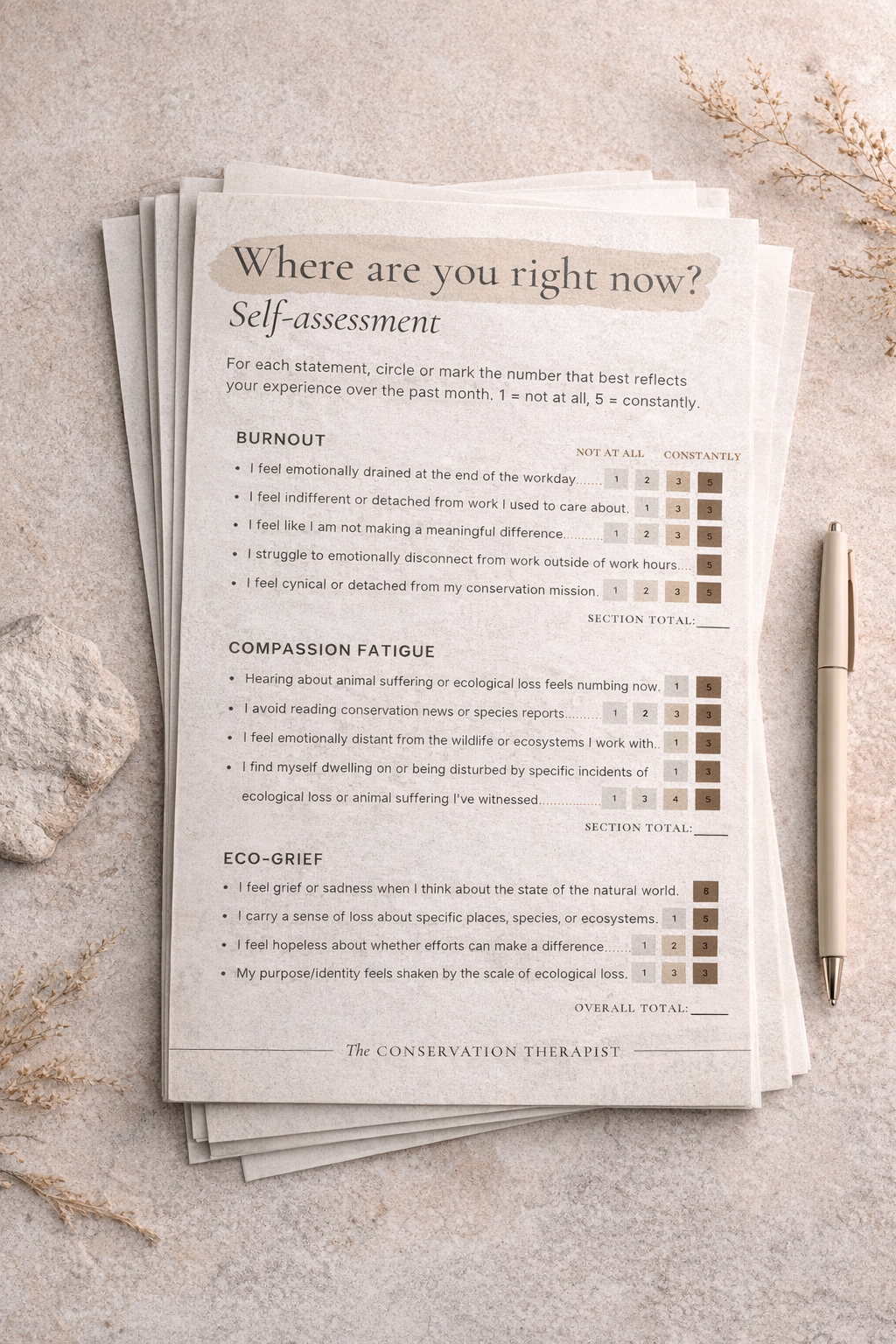 Image 4 of 5
 Image 5 of 5
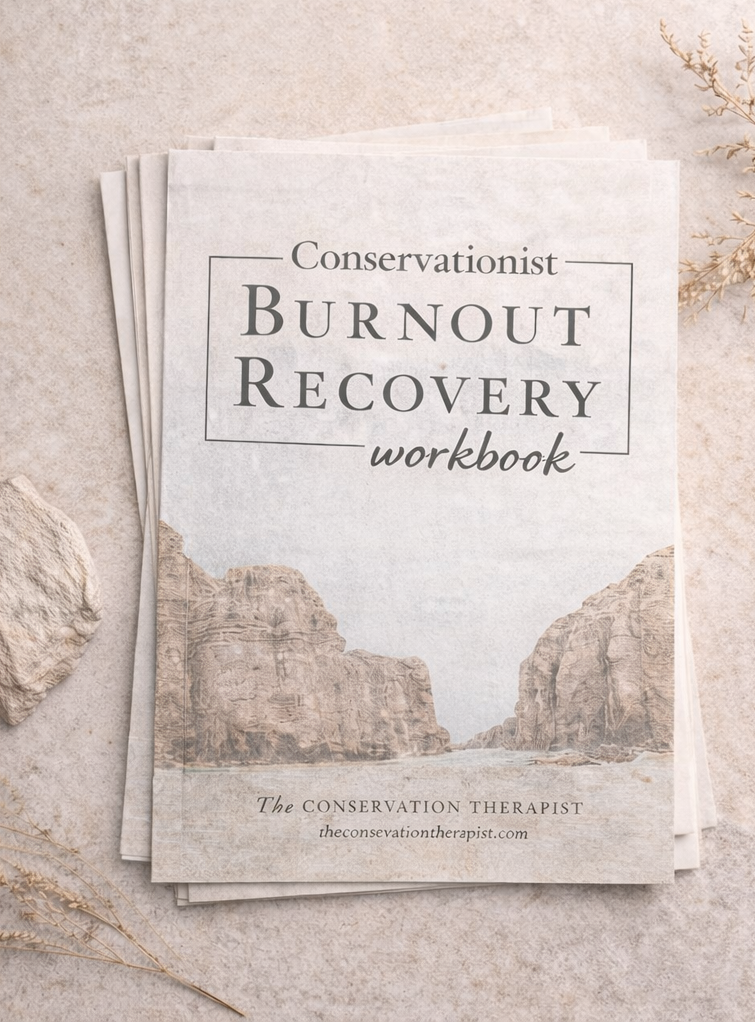
If you work in conservation, ecology, or wildlife — and you're running on empty — this workbook was made for you.
Written by a Licensed Professional Counselor, the Conservationist Burnout Recovery Workbook is a self-paced, evidence-informed digital resource designed specifically for conservation professionals navigating burnout, compassion fatigue, and eco-grief.
WHAT'S INSIDE
The workbook moves through seven sections:
→ What Is Conservation Burnout? — Understand the three faces: burnout, compassion fatigue, and eco-grief, and why each requires a different response
→ Self-Assessment — A research-informed assessment across all three dimensions, with guidance on interpreting your scores
→ Your Burnout Journey — Prompts to trace how you got here, without blame — including a burnout timeline
→ Mapping Your Stressors — An exercise to see the full picture of what you're actually carrying
→ Practical Recovery Tools — Evidence-based tools adapted for conservation workers: nervous system support, boundary-setting, grounding practices, and more
→ Renewal for Resilience — Reflection prompts for building something more sustainable, not just recovering from burnout
→ Next Steps & Support Network — When to reach out, how to build a support system, and what comes after
WHO THIS IS FOR
→ Wildlife biologists and field ecologists
→ Conservation nonprofit staff and volunteers
→ Park rangers and land managers
→ Environmental educators and researchers
→ Marine biologists and oceanographers
→ Graduate students in environmental sciences
→ Climate scientists and policy advocates
→ Anyone who loves the natural world and is running on empty
HOW TO USE IT
This workbook is yours to use at your own pace. There is no timeline and no right way to move through it. You can complete sections in a single sitting or return to them over weeks and months as you need to.
It is designed as a companion to therapy, peer support, and community — not a replacement for it. A "When to Reach Out" section at the back helps you recognize when more support is needed.
ABOUT THE CREATOR
This workbook was created by Brittany Sawrey-Coulson, Licensed Professional Counselor. Brittany is a trauma therapist in Scottsdale, Arizona with a previous career in conservation — zookeeper, NGO work, and fieldwork — and holds an MSc in Conservation Science and an MC in Counseling.
She created The Conservation Therapist because the mental health resources available to conservation professionals didn't speak their language. So she built resources that did.
DETAILS
→ Format: Instant digital download — PDF
→ Compatible with Adobe Acrobat, Preview, and most PDF viewers
→ Can be printed at home or used digitally on a tablet
→ No physical product will be shipped
PLEASE NOTE
This workbook is a self-reflection and psychoeducational resource. It is not a clinical assessment instrument and is not a replacement for professional mental health support. If you are experiencing significant distress, please reach out to a licensed mental health professional.
If you work in conservation, ecology, or wildlife — and you're running on empty — this workbook was made for you.
Written by a Licensed Professional Counselor, the Conservationist Burnout Recovery Workbook is a self-paced, evidence-informed digital resource designed specifically for conservation professionals navigating burnout, compassion fatigue, and eco-grief.
WHAT'S INSIDE
The workbook moves through seven sections:
→ What Is Conservation Burnout? — Understand the three faces: burnout, compassion fatigue, and eco-grief, and why each requires a different response
→ Self-Assessment — A research-informed assessment across all three dimensions, with guidance on interpreting your scores
→ Your Burnout Journey — Prompts to trace how you got here, without blame — including a burnout timeline
→ Mapping Your Stressors — An exercise to see the full picture of what you're actually carrying
→ Practical Recovery Tools — Evidence-based tools adapted for conservation workers: nervous system support, boundary-setting, grounding practices, and more
→ Renewal for Resilience — Reflection prompts for building something more sustainable, not just recovering from burnout
→ Next Steps & Support Network — When to reach out, how to build a support system, and what comes after
WHO THIS IS FOR
→ Wildlife biologists and field ecologists
→ Conservation nonprofit staff and volunteers
→ Park rangers and land managers
→ Environmental educators and researchers
→ Marine biologists and oceanographers
→ Graduate students in environmental sciences
→ Climate scientists and policy advocates
→ Anyone who loves the natural world and is running on empty
HOW TO USE IT
This workbook is yours to use at your own pace. There is no timeline and no right way to move through it. You can complete sections in a single sitting or return to them over weeks and months as you need to.
It is designed as a companion to therapy, peer support, and community — not a replacement for it. A "When to Reach Out" section at the back helps you recognize when more support is needed.
ABOUT THE CREATOR
This workbook was created by Brittany Sawrey-Coulson, Licensed Professional Counselor. Brittany is a trauma therapist in Scottsdale, Arizona with a previous career in conservation — zookeeper, NGO work, and fieldwork — and holds an MSc in Conservation Science and an MC in Counseling.
She created The Conservation Therapist because the mental health resources available to conservation professionals didn't speak their language. So she built resources that did.
DETAILS
→ Format: Instant digital download — PDF
→ Compatible with Adobe Acrobat, Preview, and most PDF viewers
→ Can be printed at home or used digitally on a tablet
→ No physical product will be shipped
PLEASE NOTE
This workbook is a self-reflection and psychoeducational resource. It is not a clinical assessment instrument and is not a replacement for professional mental health support. If you are experiencing significant distress, please reach out to a licensed mental health professional.